Thursday, June 18, 2015

Madrid: The Top 10

After ten days in Madrid (including a couple of small trips outside), I can hopefully compose a "top 10" post. I learned that Madrid, like many large cities, is divided into various neighborhoods, each of which has a distinct personality. So, I will organize my hit list by neighborhood. I should mention, if you like to walk and have comfy shoes, you can get to everything listed here on foot. If it's too hot or you want to save your energy, use the very clean and user-friendly Madrid Metro.

Important note for students and teachers: Anything in Spain that is considered "patrimonio nacional" (basically all museums and historical sites), is FREE for you, so be sure to bring your ID.

So, what to do in Madrid... let's start at the center of the city, Puerta del Sol.

1. La Mallorquina. Serving traditional Spanish pastries since 1894, La Mallorquina, in the plaza Puerta del Sol, is a dangerously delicious way to start the day. Walk right in and order in the front of the store for a pastry to go, or stand at the bar in the back for a coffee/tea and sweet. If you go upstairs, you can sit at a table and be waited on.
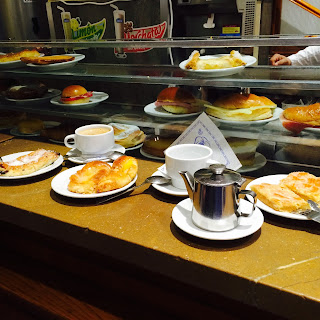
Breakfast at the bar in La Mallorquina
Moving on to "the classics"... a short, winding walk westward from Sol will take you to La Opera/Palacio district.

2. Plaza Mayor. From Puerta del Sol to Opera/Palacio, stop by Madrid's main plaza, one of those tourist must-sees. I actually found the walk to and from a lot more interesting than the plaza itself, especially on a very hot, sunny day with no shade in sight. Just around the block is the Mercado San Miguel, a great place to grab a snack.
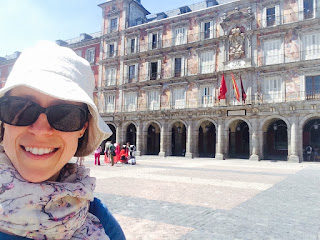
Intense heat and sun in Plaza Major
3. Palacio Real (royal palace). The official palace of the Spanish government, build in the first half of the 18th Century, the palace has about 3,000 rooms, 23 of which are open for tourists to visit. A great respite on a hot, sunny day, a walk through the palace is a nice place to start a visit to Madrid. Whether or not the Spanish royal family still live there is questionable... I heard both answers from reputable sources.
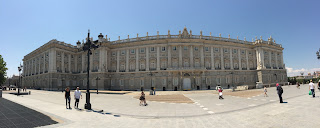
Palacio Real
In the other direction, in the areas of Parque del Retiro (an attraction in itself) and Atocha...

4. Museo del Prado. Of course, this truly must-see could take a week. Or, you could go in with a plan. Pick up the museum map at the info desk as soon as you walk in, and target your visit to the masterpieces list. For 5 euros at the gift shop, you can buy a small guide to the 50 masterpieces, which has an easier to navigate map, as well as pictures and descriptions of all of these major works. Well worth it, as is the visit to one of the most celebrated art museums in the world.
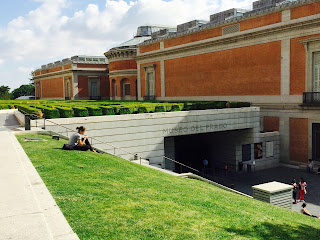
Resting after a marathon visit to Museo del Prado
5. Museo Reina Sofía. Although they are neighbors, I would not suggest attempting both Prado and Reina Sofía in the same day, unless the only thing you want to see at the latter is Picasso's Guernica. That being said, Guernica alone would actually be a perfectly acceptable -better said, spectacular- reason to enter the Reina Sofía Museum.
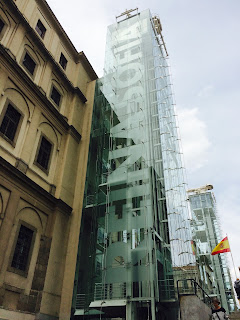
Museo Reina Sofía: More modern than expected
The rest of my Top 10 are neighborhoods themselves, and a few interesting things to discover in each one. We'll work our way walking back from Reina Sofía to Puerta del Sol and then farther north.

6. Lavapiés. A historically working class neighborhood, Lavapiés is the most diverse area of Madrid: dynamic, colorful, and definitely the place to go when you are tired of Spanish food. In this neighborhood, you will find authentic Asian, North African, and Latin American restaurants, as well as interesting art galleries, including La Tabacalera, former tobacco factory turned art/community center. During my first visit to Lavapiés, I walked into the plaza and passed by an Indian restaurant playing salsa music, bought a lychee juice at a corner shop, and admired beautiful Turkish pastries at a bakery. A few days later, I returned and ate my favorite lunch in Madrid at the Restaurante Achuri (delicious dishes and great vegetarian options!).  
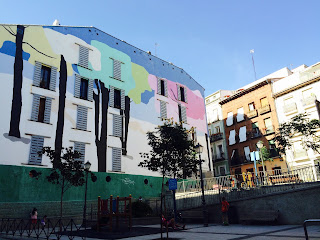
Barrio Lavapiés, home to a diverse community and thus, great restaurants! 
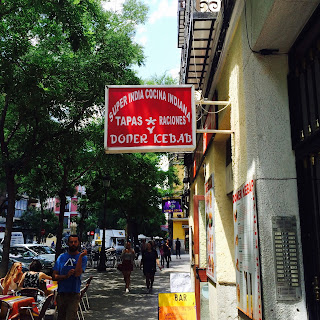
An example of hybridity in Lavapiés: An Indian restaurant offering Spanish tapas and raciones, as well as kebab
7. Las Letras. Poetry in the street, literally. In Las Letras neighborhood, the streets are named for literary figures, and passages from Spanish poems and prose are embossed in gold letters into the sidewalks. It's hard to walk without stopping to read. Not to mention, there was a great antique market going on as part of an art/deco festival last weekend. Local businesses showed off their creativity with spectacular window displays, inside and out.

Awesome window/shop displays in Las Letras


Finally, on the north side of Puerta del Sol...

8. Museo Sorolla. What a treat! This museum was the home of Spanish impressionist artist, Joaquin Sorolla y Bastida, and its courtyard and gardens are nearly as beautiful as the paintings. Sunlight, sea, and family life were Sorolla's primary subjects, and the paintings are truly luminous.
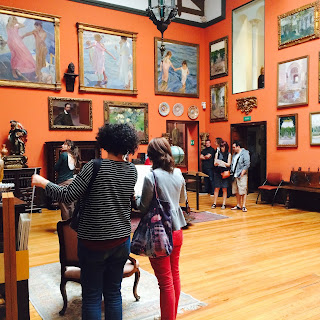
Inside Sorolla's studio
9. Chueca. Known as Madrid's center for LGBTQ pride, Chueca is full of colorful shops and trendy cocktail lounges. Also of note are a few fresh juice bars and a gluten-free bakery, and the upscale Mercado San Antón.
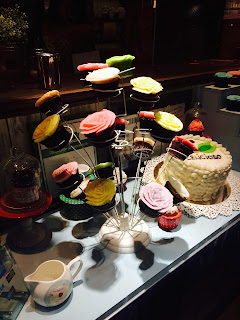
Too pretty to eat? Gluten-free cupcakes in Chueca

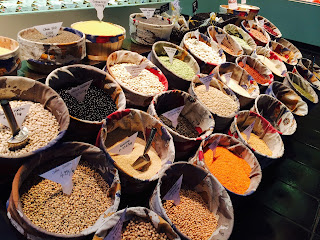
Spices at the Mercado San Anton, in Chueca    
10. Finally... Malasaña. Adjacent to Chueca, Malasaña is the "hipster" area of Madrid. Pedestrian streets make for easy window (or real, if you so desire) shopping in the neighborhood's numerous designer shops and elegant boutiques. What did I notice in Malasaña? Lots of tea shops! If you want to buy tea, go to Malasaña.

Madrid, like any big city, can be overwhelming at first, but when you look at it as a group of unique neighborhoods, it's easy to appreciate the city's diversity and charm. So take a walk outside the typical sites, eat some great food, and enjoy the nonstop night life of MAD.


Saturday, June 13, 2015

Food in Madrid: Green eggs and ham?

Admittedly, I have only been in Madrid for a week. Still, I can certainly say that the major culinary emphasis here is ham, of many types. There is even a Museo del Jamón down the street. Very impressive, but perhaps not the best environment for a vegetarian.
Various types of ham, with a bit of manchego cheese, another ubiqitous item

A fried egg and chunks of ham on top of "pisto", a tomato-based, vegetable stew

For those of us attempting to not eat ham, there is no shortage of protein in the form of eggs. I have had many slices of tortilla de patatas (a big, thick, potato pancake cut into slices like a pizza), but beyond this, eggs are added to everything else... even things you wouldn't suspect, like gaspacho (as bits of hard boiled egg sprinkled on top). I have to say, this week I have felt a little bit like Sam I Am from the beloved Dr. Seuss book (especially where the ham is concerned). Not to worry, I have made up for any missing calories in the form of sweets!

Apparently, cloistered nuns make the best cookies. In Chinchón, a small town about an hour outside Madrid, eight sisters in the Convento de las Hermanas Clarisas sell simple, but delicious, cookies involving flour, butter, sugar, and eggs (with various nut options). Your purchase is a tasty contribution to a good cause.

Almost gone... butter cookies baked by nuns in Chinchón

Of couse, I had to try the Spanish classic, churros con chocolate... fried dough sticks to be dipped in sugar or thick hot chocolate with the consistency of pudding. A pleasant surprise was the popularity of frozen yogurt. So far my favorite is Llaollao, a franchise froyo place that combines fresh fruit granizado (imagine a watermellon slush) with natural frozen yogurt, more fruit, and warm, creamy toppings like white chocolate sauce. YUM! 

Churros con chocolate

My sensacion from Llaollao 


Tuesday, June 9, 2015

Pocos días en España: More on speaking the wrong kind

Hola de Madrid! A couple months ago, I wrote a post about language differences and "speaking the wrong kind". My first time in Spain, I am attending a CIEE International Faculty Development Workshop on intercultural development this week. Of course, when it comes to intercultural anything, the first thing on my mind is language. In this case, I came here wondering, what happens to people (e.g., me) who speak Latin American Spanish in Spain? How are they (we) perceived? What adjustments might need to be made to facilitate communication, and how do these affect the speaker's identity?

For months, I have been trying to find an article or blogpost I know I read about Latinos in Spain, from a language perspective. I remember clearly that the author, a Latin American immigrant to Spain, talked about speaking the same language, but constantly being made to feel that her Spanish was incorrect, not "proper", or somehow lacking. Interestingly, one of my colleagues at the seminar has lived this experience, and we had a very enlightening conversation about it.

My new friend, who I thought was, without a doubt, Spanish due to her way of speaking, told me yesterday that she is really, in fact, from South America. My immediate response: "No! Wow! I was sure that you were Spanish. How did you change your entire way of speaking by living here?"

She said it wasn't that difficult, but she also felt obligated to do it. Without speaking like a Spaniard, she felt she would always be considered an outsider, a foreigner, and she didn't want that. She has lived here for 15 years, is married to a Spaniard, and has children born in Spain. Still, however, to the native Spanish ear, her language is still not perfectly local- she has been called out on minor, pragmatic nuances (the differences in usage between escuchar vs. oír, for example).

I tried to imagine what this would be like. It feels so awkward for me to say, "graTHias" or "plaTHa", and pronunciation is really just a minor detail. There are systematic, grammatical differences as well, and, of course, lexical differences on many levels. I spoke with another seminar participant about it as we walked to meet the group for tapas. I said, "imagine moving to say, England, and feeling like you had to completely change your accent and vocabulary, your language use. Wouldn't this affect your identity?". As it turns out, the guy I was talking with is a Canadian living in the U.S. (and nothing about his language indicated this to me). He said that his language has defintely changed since he moved south to complete his college education and begin working as a professor. Now, in fact, when he goes to see his family in Canada, they tell him he speaks like someone from the U.S. But, he insisted, this is no big deal; it just happened naturally.

So, I concluded, maybe it really isn't that hard, not that dramatic or life-changing. Maybe it's just another one of the many, major and minor adaptations immigrants go through when relocating to a different place. However, the variations between Canadian and U.S. English don't seem nearly as plentiful (or linguistically complex) as those between the Spanishes (but maybe that's only my perception as a second language speaker). In any case, the more important difference is that the Canadian in the U.S. shifted his language almost involuntarily, without really thinking about it ("no big deal"). The South American in Spain, at least to my ear, drastically changed her language on purpose, with a sense of obligation and necessity. This is the impact.

So I am here, just for 10 days, speaking "the wrong kind" of Spanish, and finding more questions than answers. More to come about Madrid, a la turista.

Can you say gnocchi in Spanish?


Friday, June 5, 2015

A summer of intercultural journeys begins... Madrid awaits!

You know how teachers get at the end of the school year? The anticipation, the countdown, the desperation for a break? That's exactly how I was feeling about a month ago. Happily, the semester ended, I finished all the grading, and the university parking lots cleared out. A couple weeks ago, I attended graduation, hugging each of this year's nearly 20 grads who earned their Bachelor's degrees with a minor in Speech-Language Pathology.

For university educators (and many K-12 teachers, as well), summer break is just a myth. That is, the end to teaching does not mean the end of work. In fact, everyone seems to have a huge list of summer projects: data to analyze, papers to write, conference proposals to submit. My focus this summer is a bit more hands-on (and fun!): intercultural learning and development. Even though I have personally experienced intercultural learning, I am just now studying the theories and research related to it. Delving into this field is important, due to my involvement with global service learning and the development and teaching of related courses at my university.

I began the summer by co-presenting at the NAFSA Annual Conference & Expo, in Boston, last week. NAFSA focuses on all things international/global in education: study abroad, global service learning, advocacy, international student services, and social responsibility in international education, for example. It was my first time at this conference, and I loved it! My goal was to learn how to better prepare students, as well as how to develop sustainable projects for our college's global service learning in Guatemala. I learned so much about research on cultural competence, how to engage students in international contexts, dimensions of culture, and potential ways to bridge cultural chasms.

The Expo at NAFSA: Candyland for international education junkies

Next on the agenda is a CIEE Faculty Development Seminar on Intercultural Development, in Madrid, Spain. I can't wait! There has been quite a bit of preparation for the seminar. For starters, I took the Intercultural Development Inventory (IDI), a well-established, valid tool for assessing and coaching intercultural development. The IDI experience included a 12-page profile and a one-hour, individual debriefing with a trainer. Results show that my perceived level of intercultural development (acceptance) is higher than my actual level (minimization). No worries, though, as I also received a lengthy, individualized development plan to help me move to the next level.

The IDI continuum. See http://idiinventory.com 
One thing I learned already, and it may seem obvious (but since I'm a minimizer I tend to think everyone is the same), is that everyone's goals for international education are different, and that everyone is in a different place in their own intercultural development. Thus, in planning global service learning experiences and preparing our students, we need to start where they are and have realistic expectations of what they will get out of the experience.

A few other things I have been exploring in the area of intercultural learning:

1. The Hofstede Center: A tool that allows you to compare two countries on 6 cultural dimensions. Obviously, this is not all you need, but it's a great start.

2. globalsl.org: I think I've already mentioned this, but it's a valuable resource for global service learning research and practice. They also have a blog.

3. Developing cultural mindedness: A guidebook for generating stronger intercultural service. After attending an IARSLCE webinar on global service learning, one of the participants, Kathryn Burleson,  emailed me with this excellent tool, which she developed.

4. Purdue University's Passport to Intercultural Learning (PUPIL), recommended at NAFSA, a strong model for how institutions of higher education can promote students'  intercultural learning.

5. Vande Berg, Paige, and Lou's (2012) book, Student learning abroad: What our students are learning, what they're not, and what we can do about it. I read a couple chapters for the CIEE seminar, and it's a worthwhile read. It was also recommended at NAFSA.

6. For those of you looking for research articles, the Michigan Journal of Community Service Learning (from U. MI), current issue, has a special section on global service learning.

In a future blog, I'll talk about strategies for developing/practicing intercultural awareness and communication. Stay tuned for touristy posts from Spain, as well. ¡Nos vemos en Madrid!


Enjoying Boston at the NAFSA Conference


Thursday, May 14, 2015

Poetry of immigration, and being in the middle-ground

I have been tutoring ESL and literacy since the beginning of this school year at an adult education center. Almost every student attending this awesome school is an immigrant, in various stages of education and English language acquisition. I have been working with a group of four inspiring women, from Brazil, China, Guyana, and Morocco. Each one has a different home language/s, a different journey, and a different story.

A couple of weeks ago, we read Deb Smith's insightful blogpost, "I am a triangle", which beautifully illustrates the process of moving to a different culture, acculturating to a certain extent, fitting in to a certain extent (but never fully), and then returning to your home culture to find that you don't quite fit in there, either.

Deb's metaphor is that you begin as a circle, growing up and living in a circle culture, where you fit in and are comfortable. You then move to a square culture. At first, you are still a circle, and so you feel lost in the square world. Eventually, with time, you adapt, but can never really be a square. So, instead, you approximate, and become a triangle. The challenge is, when you return to your home country, circle culture, you remain a triangle. Thus, you never really feel at home in either culture. Deb has great illustrations for this process.

I absolutely experienced this myself when I was living in Chile. I adapted so much I almost became a square. However, not having shared my childhood with the squares of Chile sometimes gave me pointy edges... I was really just a triangle. Coming back to the U.S. was always a challenge: I was still a triangle. Of course, this was many years ago, so now I am back to being a circle and living in a circle culture (for the most part). In contrast to my experience in Chile, during my brief stay (4 months) in Italy last year, I didn't become a triangle. I basically stayed a circle in a square culture, a challenge that I came to accept knowing my stay there was only temporary.

After analyzing and discussing Deb's metaphor, my students wrote their own reflections on this phenomenon. Two of them, who have been in the U.S. 8+ years, considered themselves triangles. Laughing at their early cultural-linguistic faux pas, they decided that they have changed over the years, but still have a lot to learn. They realized that, if they went "home" now, they would see things differently, and might not fit into the cultural practices that once simply felt like water to a fish.

Another student, who recently celebrated her one-year anniversary in the U.S., feels that she is still a circle in a world of squares... still on the outside, trying to figure things out. She is frustrated with the language and is not comfortable or happy here. However, she cannot go back. She has no choice but to wait it out, keep trying to adjust, and hope to eventually shift her shape.

All of this got me thinking about theory and literature. There is actually a lot of scholarship about border culture (Anzaldúa, 1999) and third-spaces (Bhabha, 1994), places of hybridity. Immigrants experience, perhaps necessarily, the identity crisis that arises from the tension of existing in the middle-ground, neither here nor there. I wrote about these theories and their embodiment in the story of "Manuel", in a recent article, The meaning of roots: How a migrant farmworker student developed a bilingual-bicultural identity through change.

So, our next project, in the tutoring group, is to explore these middle-groud spaces by writing our own immigration poetry. For inspiration, we learned about Angel Island and read some of the poems discovered there, written by detained immigrants from China in the early 1900's. I have found some good immigration poems on Power Poetry, which also offers tips for writing. Here's a great bilingual poem by Gustavo Perez Firmat.

Of course, I am reminded of my favorite poem, Gabriela Mistral's Desolation, which spoke so powerfully to me when I was living in Chile. In Desolación, Mistral is not in a foreign land, but in Patagonia, the extreme south of her own country, showing that differences in regional cultures and climates can shock a migrant, too.

Feeling triangular after about 5 years in Chile
I can't wait to hear my students' poems. Hopefully, I will be able to publish them here. Stay tuned, and feel free to post resources for immigration poetry.

Wednesday, April 29, 2015

Language DOES influence thought! I have proof...

You know that feeling, when you have a knot in your stomach? If you could draw a picture of that knot, what would it look like?

One of the many challenges of learning a second language is understanding figurative language. Metaphors and idioms vary across different languages; for example, when something costs "an arm and a leg" in English, it costs "an eye of the face" (un ojo de la cara) in Spanish (and also Italian: costa un occhio della testa). As a general rule, idioms do not translate well. Instead, you have to learn the equivalent expression. Here are some great idioms unique to various languages.

Based on this, it was totally predictable that one of the adult ESL students I tutor, from China, didn't understand the expression, to have "a knot in one's stomach". Trying to help the students infer the meaning of this idiom, I asked, "Well, what is a knot?" (looking for a literal explanation). To my surprise, my Chinese student drew a picture that looked something like this:

Image excerpted from http://www.chipellis.com/Writings/writings.htm
Wait a minute! That's not the kind of knot I envision in my stomach when I feel nervous or upset. In fact, that's not even my image of a literal knot. Explaining this, I drew my version of a knot:

My drawing of "knot"
To explore this difference, we googled images of "Chinese knots", and discovered a bunch of things that look like this:

From http://www.chinatravelpage.com/chinese-knot-a-symbol-of-china 

Again, at least for me, this is not a "knot", and is definitely not the type of thing you have in your stomach just prior to, say, a public speaking engagement.

So, I came away from that tutoring session with an enhanced understanding of how language affects the way we think, a topic that has woven itself (hey, there's another metaphor!) throughout my current semester. It's easy to see how our thoughts might influence our language, but does it work the other way around?

As an opener for my Language Development class this term, the students listened to the Radio Lab program, "Words", which recounts a series of intriguing stories of people who experience ways in which language has a clear impact on cognition. My class had a great discussion about this program, and the language-thought relationship has continued to be an important theme of the course.

Shortly afterwards, NPR published an article on the same topic, which I actually brought in to read with my ESL tutoring students. The article was a challenging read for my students, and they didn't seem to really connect with the idea that language could influence our thoughts. Until, a couple months later, we had the conversation about knots.

Hence, I hear, "knot", and imagine a tangled up ball of string: the mess you can't get out of your shoelaces, or a necklace. My Chinese student hears, "knot", and thinks of a beautiful, intricate and organized pattern used for decoration and good wishes. Certainly, this divergent conceptualization of "knot" would influence the interpretation (and perhaps even existence) of the idiom, "knot in the stomach". One thing I am not sure of is whether there is a similar idiom in Chinese to express this feeling of anxiety. However, I am sure of this: language -and all the cultural connections that come with it- do influence our thoughts and the way we see the world.


Wednesday, April 22, 2015

Speaking "the wrong kind"

Have you ever been somewhere where you speak the language, but speak "the wrong kind" of that language? Languages often have different varieties, AKA dialects. For example, the way English is spoken in the U.S. vs. Australia vs. Ireland. Speakers from these countries are mutually intelligible; however, we use different phonological patterns and lexical items. You don't even have to go to another country to experience this: within countries there are also regional and cultural dialects. Here's an excellent illustration of regional varieties of English in the U.S.

At the West Side Market, Cleveland, OH.
Lately, I have seen a few examples of this, speaking the wrong kind of a language, and they reminded me of some of my own experiences. Last year, in Italy, for example, it was a very lonely day when I realized I spoke not only the wrong kind of English (Italians often learn British English and I also happened to be working with a British, English language immersion school), but also the wrong kind of Spanish (duh... Spain is a lot closer to Italy than Latin America). I clearly remember the disheartening sensation. I was already feeling like an outsider thanks to my "emerging" Italian. Speaking English, of course I could communicate fairly easily with the teachers and students at the British school; however, they sometimes used mysterious expressions like "tuck shop". One day, I overheard a Spanish teacher talking to a student there, ¡en puro español de España! I decided right then and there, I simply would never fit in in Italy.

Speaking the right or wrong kind of a language is definitely a question of fitting in. Yesterday, a student sent me an episode of TED radio hour, "Spoken and Unspoken". An excellent program... the second episode was based on the work of Mark Pagel, who researches evolution in language and culture. He explained this idea:

"... it's as if we use our language almost instinctively and subconsciously as a marker of tribal identity. As soon as someone opens their mouth and we hear their accent, we start to place them. And what we're subconsciously doing is saying, are they one of us?"

What happens if you are the one who is not part of the tribe? This reminded me of one of my current students, who immigrated from Guyana, an English speaking country, but always talks about how much she had to learn when she first arrived in the U.S. She spoke English, but not the right kind. 

Another friend confided recently that her brother, a native English speaker, had been an undocumented immigrant and was recently deported from a different, English-speaking country. Why? In part, because he couldn't "pass" for a local due to his accent.  

Along these lines, the powerful documentary film, El Coyote, by Chema Rodríguez, chronicles the supposedly final voyage of Mexican coyote, Maco, as he leads a group of migrants from Honduras to cross the U.S. border. In part of the film, he explains how he coaches his clients to speak like Mexicans, so they can pass for locals as they cross the country.         

You might not imagine that people in Mexico would speak so differently from people in Guatemala, or Honduras, but it's true. As it turns out, Spanish is a great example of a language with many kinds. I mean, how many different ways can we say, "beans"? Frijoles, habichuelas, porotos... After living in Chile for a few years, I visited Buenos Aires. Claro que sí, I spoke Spanish, but I had a very serious case of Chilean Spanish, which conflicts with Argentinean Spanish on so many levels! 

Nowadays, my Spanish is more "generic", but I still run into a lot of differences. For example, I was taken by surprise when, at a restaurant in Puerto Rico, I asked what kind of juice was available and didn't understand any of the four options! As it turned out, two were fruits I knew, named in different ways (e.g., "china" for "naranja"), and two were local, tropical fruits whose names I had never heard.

Of course, that feeling of belonging seems to come back when you run into someone or something that reminds you of "your kind" of language. Growing up in Ohio, I used words like "pop" (the fizzy drink) and "tennies" (athletic shoes). Although nowadays, I usually say, "soda" and "sneakers", I feel a fond connection whenever I hear someone use my "native" terms. I guess we never forget our original language kind.